AM4’s Last Good Year: The Board Check That Decides a £180 Ryzen Upgrade in 2026
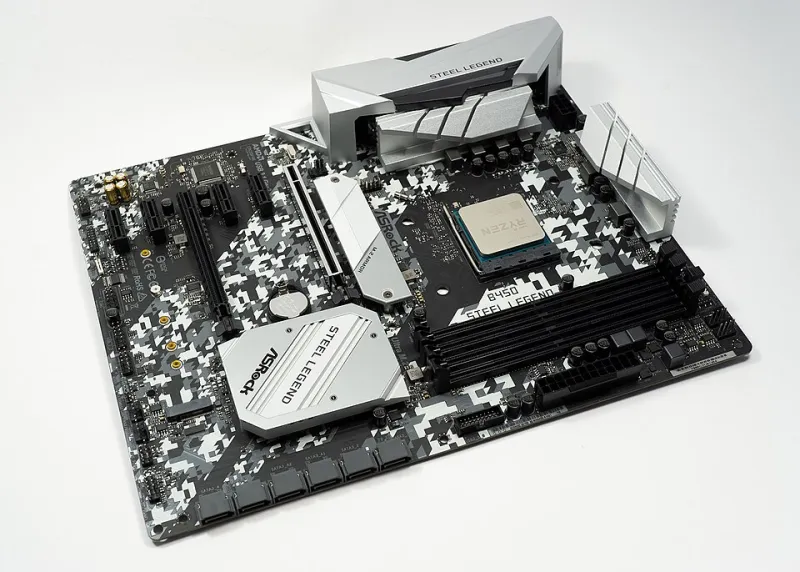
Photo: Oligopolism, CC0, via Wikimedia Commons
AM4 is the hardware equivalent of a well-worn estate car. It is not exciting, but it starts every morning, parts are cheap and there is still an enormous amount of it about. If you are running a Ryzen 5 2600 or a 3600 in a B450 board, a drop-in Ryzen 5000 chip can feel like a new PC for less than the cost of a mid-range graphics card. The catch is that not every AM4 board deserves another penny in 2026. Before you buy anything, run the board check below.
Check the board, not the badge
AM4 covers everything from A320 boards that should have been retired years ago to X570 boards with more phases than a small substation. The badge alone tells you very little. Find the exact model and revision — it is printed on the board, not just in the spec sheet — and open the manufacturer’s CPU support list. You are looking for two things: whether your intended chip is listed, and which BIOS version adds it.
This is the step most people skip. A board can have an AM4 socket and still refuse to POST with a Ryzen 5000 chip until it has the right AGESA firmware. If the board has BIOS Flashback, you can update without a CPU. If it does not, you need the old chip installed and a USB stick formatted FAT32. Some early boards need a bridge CPU to reach the BIOS that supports Ryzen 5000. That is not a disaster, but it is a £15-25 job at a local PC shop if you do not have a spare AM4 chip.
VRM: the bit that decides how far you go
VRM quality matters more with 105W chips. A 5600 at 65W is fine on most B450 boards, even ones with small heatsinks. A 5700X3D is also efficient in normal use, but it can pull short bursts that make a weak board work harder. A 5800X3D or 5950X on a budget B450 with no VRM heatsinks is asking for throttling, fan noise or worse. If your board has four phases and no heatsinks, stick to a 65W six-core and put the savings into a cooler.
That is not snobbery. It is just a recognition that a £180 CPU on a £60 board from 2018 is a mismatch. The motherboard was never designed for that sustained load, and the VRM will let you know about it under a long compile or a hot afternoon.
Cooler and case clearance
Most AM4 boards keep the same mounting holes, so an existing tower cooler often carries over. The stock Wraith Stealth is fine for a 5600 in a ventilated case, but it is not fine for a 5700X3D under sustained load. Budget £30-45 for a 120mm tower cooler — a Thermalright Peerless Assassin, DeepCool AK400 or be quiet! Pure Rock 2 are the usual UK suspects — and check the case clearance before ordering. Also check RAM height: a big cooler can overhang the first DIMM slot.
UK prices and stock in 2026
New Ryzen 5 5600 chips have settled around £95-110 from Scan, CCL, Ebuyer and AWD-IT, with used examples on CeX or eBay UK closer to £65-80. The 5700X3D is the interesting one for gaming: expect roughly £170-200 new, sometimes less on offer. The 5800X3D is mostly a used-market chip now, and at £200-plus it is hard to justify over the 5700X3D unless you specifically want the last word in AM4 gaming. Avoid the Ryzen 5 5500 unless it is very cheap; its cut-down cache and PCIe 3.0 support make it a false economy next to a 5600.
The 5900X and 5950X only make sense if you already have a strong X470 or X570 board, good cooling and a workload that uses the cores. For most UK home offices, a 5600 or 5700X3D is the sensible ceiling.
The £180 stopping point
Here is the arithmetic that matters. A used 5600 at £70 plus a £35 cooler is a good upgrade if your board already supports it. A 5700X3D at £180 plus a £40 cooler plus £20 for a shop BIOS flash is £240. At that point you are within touching distance of a basic AM5 bundle — a Ryzen 5 7600, B650 board and 16GB of DDR5 can be found around £300-350 in the UK this year, and it comes with a fresh platform, warranty and an upgrade path. If you also need a new PSU, case or DDR4 kit, stop. Put the £180 toward AM5 instead.
A quick pre-flight list
- Board model and revision confirmed
- BIOS version supports the chip
- VRM has heatsinks or the chip is 65W
- Cooler rated for the TDP and fits the case
- 16GB RAM in dual channel
- SSD, not just a hard drive
- PSU is a decent brand and has the right cables
- Total cost stays under £250
One more UK-specific note: keep the old CPU. It is worth £30-40 on the used market, but it is also your fallback if a BIOS update goes sideways. Run the memory at its rated XMP or DOCP profile after the swap, check temperatures with HWiNFO, and give the case a clean while you are in there.
A £180 refresh is only good value if the rest of the machine is worth keeping. If the board passes the check, AM4 has one more good year in it. If it does not, do not throw good money after old silicon.